Why AWS Was the Right Foundation
The customer’s existing platform was already hosted on AWS. Adopting Amazon Bedrock for the AI layer allowed Matellio to build the solution within the existing infrastructure without introducing new cloud dependencies. Amazon Bedrock provided access to Claude Sonnet – a large language model with strong legal reasoning capability – alongside Amazon Bedrock AgentCore Runtime for agent orchestration and Amazon Bedrock Guardrails for input and output safety filtering.
AWS managed services including Amazon ECS Fargate, Amazon API Gateway, Amazon S3, and Amazon CloudWatch provided the scalable, serverless compute and observability layer required for a production-grade agentic workflow.
Why the Customer Chose Matellio
Matellio had already built the foundational phase of the company’s trademark platform and had direct familiarity with the application schema, data structures, and backend architecture. When the company required automation of conflict screening, there was no discovery phase, no knowledge transfer, and no learning curve.
Matellio brought both the domain context and the AWS technical capability to design and deliver the solution. As an AWS Advanced Partner with a dedicated AI/ML practice, Matellio was uniquely positioned to implement the LangGraph-based agentic architecture on Amazon Bedrock AgentCore Runtime and integrate it seamlessly with the existing Laravel backend.
The AI Solution We Built
Matellio built a trademark risk analysis engine that automates attorney-level evaluation of whether a proposed trademark would conflict with existing registered marks. The solution runs as a production AI agent on AWS, integrating directly with the company’s existing Laravel backend via Amazon API Gateway.
How the System Works
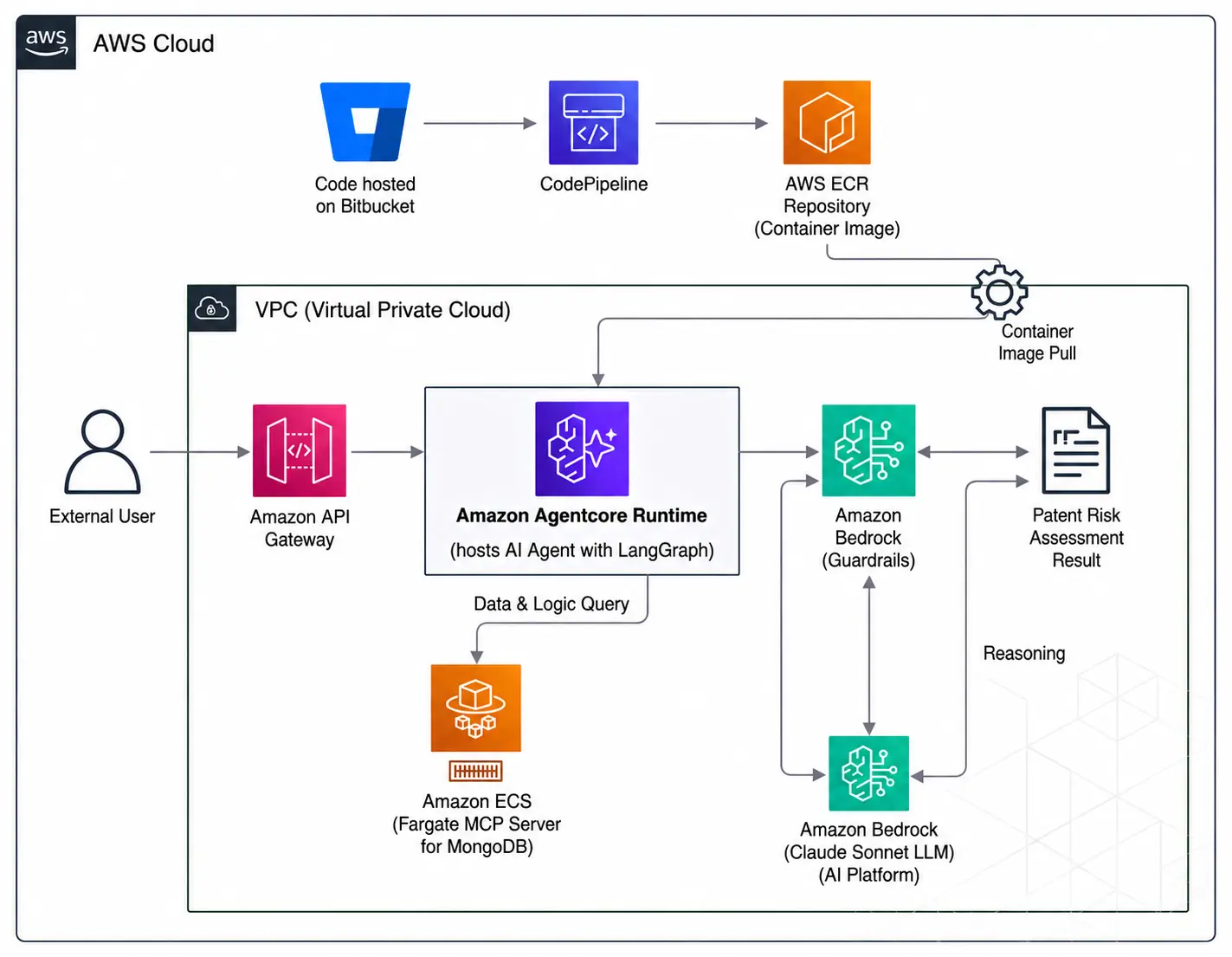
At the core of the solution is a LangGraph-based AI agent hosted on Amazon Bedrock AgentCore Runtime. The agent orchestrates the complete screening pipeline:
1. Request intake
Authenticated requests from the Laravel backend enter via Amazon API Gateway and are routed to the AI agent.
2. Trademark retrieval
The agent builds a structured MongoDB query to retrieve relevant existing marks from the USPTO database.
3. AI reasoning
Amazon Bedrock is invoked with Claude Sonnet as the reasoning model. The agent applies the DuPont likelihood-of-confusion factors across mark similarity and goods/services similarity dimensions, plus a crowded-field modifier.
4. Structured output
The model returns a risk assessment with a score from 0 to 10 and a risk level of Low, Medium, High, or Critical – with reasoning grounded in the legal rubric rather than ad-hoc judgment.
5. Safety filtering
Amazon Bedrock Guardrails filters both user input and AI-generated output throughout the pipeline.
Data Pipeline
Amazon ECS Fargate hosts a scheduled ETL task that imports USPTO trademark data daily from Amazon S3 into MongoDB. This ensures the trademark database used for conflict screening is always current, reducing the risk of missed conflicts due to stale data.
Infrastructure
Amazon ECS Fargate hosts the LangGraph agents and MongoDB MCP server. AWS IAM enforces service-to-service permissions. Amazon CloudWatch provides centralised logging and monitoring across the pipeline. Amazon ECR stores container images. AWS CodePipeline manages deployment automation
The Architecture Behind the AI Engine
The architecture below shows the full AWS deployment: the AgentCore Runtime orchestration layer, Amazon ECS Fargate container workloads, the daily USPTO ETL pipeline, and the end-to-end request flow from the Laravel backend through to MongoDB.

Business Impact & Results
Since deployment, the trademark risk analysis engine has delivered measurable improvements in attorney productivity, validated through direct time-tracking and throughput comparisons against pre-implementation baselines.
40-50%
Attorney Review Time – Reduction
Prior to implementation, an internal survey of the company’s trademark attorneys established a baseline average of approximately 30 minutes per conflict assessment, ranging from roughly 10 minutes to a full hour depending on the case and the attorney, with most of that time spent on searching and analysis rather than writing up the result. The project’s success metrics framework set an improvement target of a 30–50% reduction in average review time. The confirmed actual result is a 40–50% reduction, meeting the upper end of the target range. This improvement comes from the agent handling search, comparison, and initial risk scoring — work that previously consumed most of an attorney’s time — with the attorney now reviewing and finalizing an AI-generated report rather than building the assessment from scratch. Measurement methodology: direct time tracking, comparing attorney time spent per case before and after the agent’s assessment became available.
2×
Throughput – Increase
The same attorney survey established a baseline showing daily throughput varying widely across the team, from as few as 5–6 trademark assessments per attorney per day at one end to 30–40 at the other. The improvement target, defined in the success metrics framework, was a 2x increase in trademarks processed per day per attorney. The confirmed actual result is a 2x increase, meeting the target. Measurement methodology: a direct before-and-after comparison of trademarks processed per attorney per day, tracked through the team’s existing productivity tracking.
Consistency
Every trademark conflict assessment applies the identical DuPont rubric – eliminating variability from individual attorney judgment. Two attorneys can no longer reach different conclusions on the same case.
Accuracy
Daily automated USPTO data ingestion ensures the trademark database is always current, reducing the risk of missed conflicts due to stale data.
Structured output
Every assessment produces a consistent report with a numeric risk score (0–10) and a four-level risk classification (Low / Medium / High / Critical) — replacing variable narrative summaries.
Scalability
The LLM-powered engine absorbs increased application volumes without a proportional increase in attorney time, structurally removing the volume bottleneck from the screening process.