



When a bank calls a customer about suspected fraud or an overdue balance, the call is only useful if it is answered. Yet the outbound phone channel has quietly become the weakest link: legitimate bank numbers show up as “Unknown,” or worse, get tagged “Spam Likely” or “Scam Risk,” and customers let them ring out. Pew Research Center found that about 80% of Americans do not generally answer their cellphone when an unknown number calls, and only 19% typically pick up for a number they do not recognize. For a fraud alert, an unanswered call can mean the customer learns about the theft days later; for collections, it means a missed right-party contact.
Branded calling closes that gap by turning an anonymous ring into a recognizable, verified brand moment. This guide explains what branded calling for banks is, how it lifts answer rates for fraud alerts and collections, and how Matellio orchestrates it through Oracle OCCAS — the carrier-grade platform that sits above a bank’s existing SIP telephony, applies call authentication and Rich Call Data in real time, and unifies outbound branded calling with inbound voice security. It is one component of a broader voice security for banks program.
Why bank fraud-alert and collections calls go unanswered
Two forces work against the outbound channel at once. First, display: a bare ten-digit number carries no identity, and customers have been trained by years of robocalls to ignore anything they do not recognize — Pew found that most people who skip an unknown call will not even return it after checking voicemail. Second, reputation: carrier analytics engines score outbound traffic and apply “Spam Likely” or “Scam Risk” labels, and once a number is flagged, answer rates collapse further.
For a bank, this is not a marketing inconvenience — it is a fraud and liability problem. The phone remains a primary channel for fraud itself: the FTC reported that U.S. consumers lost $12.5 billion to fraud in 2024, that the phone was the second most common contact method, and that victims reached by phone lost the most per person, a median of about $1,500. When a legitimate fraud-alert call is not answered because it looked untrustworthy, the fraud continues, the loss grows, and the remediation cost rises. The outbound-call failure is itself a downstream fraud risk, which is why answer rates now sit alongside detection as a fraud-operations metric.
What is branded calling for banks?
Branded calling — also called branded caller ID or call branding — is technology that displays a business’s verified name, logo, and reason for the call on the recipient’s screen before they pick up. Instead of “Unknown Number,” the customer sees, for example, the bank’s name and logo with “Fraud Alert” or “Account Services.” It replaces anonymity with instant, verified recognition.
Technically, a branded call combines two things. Call authentication (STIR/SHAKEN) cryptographically attests that the bank is entitled to use the calling number, and Rich Call Data (RCD) carries the display name, logo, and call reason to the handset. Together they let carriers and devices trust the presentation and show it consistently. This is how branded caller ID works: the identity travels with the call, verified, rather than being guessed at by the receiving network.
How branded calling increases answer rates for fraud alerts and collections
The mechanism is simple: when people can see who is calling and why, and that identity is verified, they answer. The size of the opportunity follows directly from the baseline — if only about 19% of people answer a number they do not recognize (Pew Research Center), then the calls a bank loses today are mostly lost to anonymity, not disinterest. Replacing “Unknown” with a verified name, logo, and reason is what recovers them. This is now an industry direction rather than a niche tactic: Juniper Research reports that call-authentication frameworks such as STIR/SHAKEN have been adopted across dozens of countries and that branded calling is a growing global market through 2029.
For fraud alerts, higher answer rates translate directly into faster containment: a customer who answers the first alert can freeze a card or confirm a transaction in minutes rather than discovering the loss days later. For collections, branded calling raises right-party contact and lets legitimate calls reach customers instead of being silenced as spam — improving recovery without adding dialing volume. In both cases the bank is not calling more; it is being answered more.
How branded calling works: Oracle OCCAS as the orchestration core
Branded calling is not a single product bolted onto the dialer; it is an orchestration problem across signaling, attestation, and data delivery. Matellio solves it with Oracle Communications Converged Application Server (OCCAS) as the core platform. OCCAS sits above the bank’s existing SIP telephony and coordinates every step of the call in real time, so branded calling, call authentication, and inbound fraud controls run as one program rather than as disconnected point tools.
Processing SIP signaling and applying attestation
As each outbound call is set up, OCCAS processes the SIP signaling on the path. It applies STIR/SHAKEN A-level attestation — the strongest tier, asserting that the bank both originated the call and is authorized to use the number — and passes the signed identity downstream. Because this happens in the signaling layer, the verification travels with the call across carrier networks rather than depending on the receiving device to infer trust.
Injecting Rich Call Data and the branded display
Alongside attestation, OCCAS orchestrates the Rich Call Data that renders the branded caller ID: the bank’s display name, logo, and a context-appropriate call reason such as “Fraud Alert” or “Collections.” It integrates with branded-calling registration and delivery services so the presentation is registered and consistent across the major U.S. carriers, not just on a single network.
Real-time orchestration across inbound and outbound
The same OCCAS layer that brands outbound calls also authenticates inbound ones — running passive voice biometrics and deepfake detection and feeding a risk-based routing decision. That matters because voice fraud is two-sided: attackers spoof the bank’s number outbound and impersonate customers inbound. Orchestrating both from one platform means shared policy, shared reputation signals, and a single integration above the SIP infrastructure. The inbound authentication side is covered in depth in voice biometrics for banks.
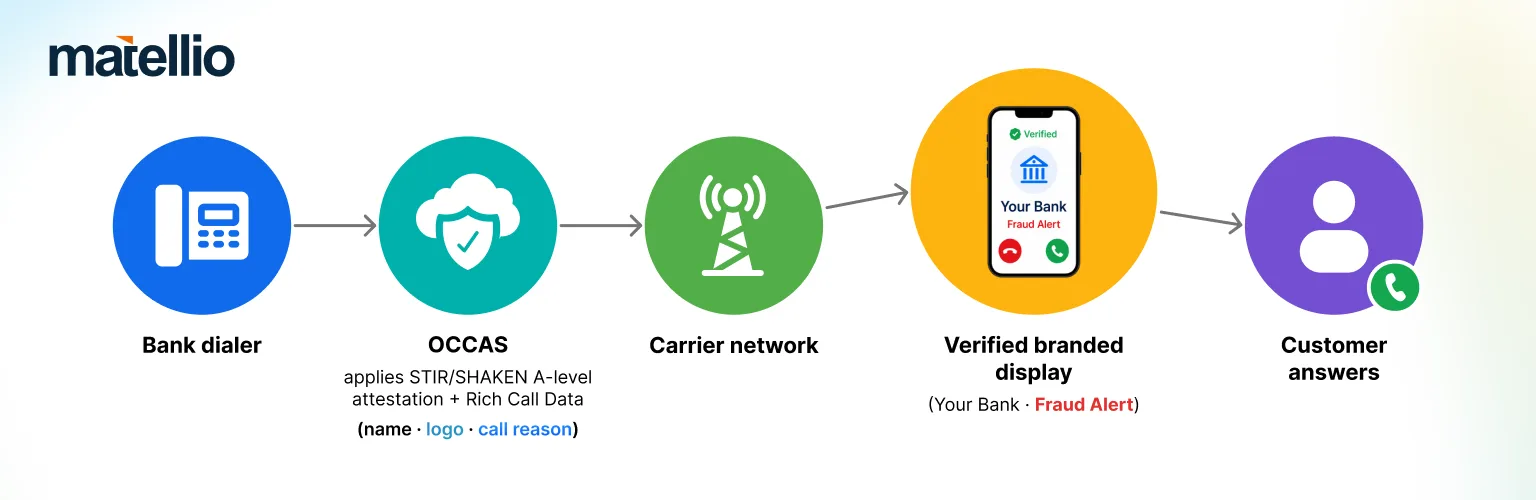
One caveat banks should understand: branding alone cannot fix a bad reputation. If the underlying signaling is unprotected, a spoofer can still impersonate the number — a branded display without call authentication can itself be faked — and if a carrier has already flagged the number, that label can override the branded presentation. In other words, a bank cannot simply out-brand a mislabel, which is why the attestation and reputation layer matters as much as the display, and why branded calling belongs inside a protected trust stack rather than on its own. Guarding the number against impersonation is the subject of phone and caller ID spoofing prevention.
Why Oracle OCCAS?
OCCAS is not a lightweight middleware layer; it is a carrier-grade application server built for the demands of real-time telecom, which is what makes it the right foundation for a bank’s voice-trust program:

Five reasons OCCAS anchors a bank’s voice-trust program — and why it adds remediation and monitoring as an overlay, without replacing the contact center.
- Carrier-grade architecture: engineered for the reliability and latency profile of live voice traffic, not batch workloads.
- SIP Servlet capabilities: a standards-based SIP Servlet runtime for building and orchestrating real-time call logic — attestation, RCD, routing, and step-up — in the signaling path.
- Oracle SBC integration: works with the Oracle Session Border Controller to secure the network edge and normalize SIP across carriers and the bank’s internal telephony.
- Scalability: scales horizontally to absorb outbound campaign spikes — fraud-alert surges or collections runs — without degrading call setup.
- High availability: clustered, redundant deployment so authentication and branding stay up during peak volume and infrastructure events.
Because OCCAS deploys as an overlay above existing SIP infrastructure, banks add branded calling and call authentication without a rip-and-replace of the contact center or telephony platform.
The business value for banks

Branded calling delivers value on several axes at once, which is why it draws budget from fraud, contact-center, and customer-experience owners together:
- Higher answer and contact rates: a verified, recognized identity recovers calls that anonymity loses today — with only about 19% of people answering unknown numbers (Pew), the display is where most of the upside sits — so alerts and collections calls reach customers.
- Reduced fraud losses: faster fraud-alert pickup shortens the window between detection and containment, cutting the loss per incident and downstream remediation cost.
- Improved customer experience and trust: customers see a recognizable, verified caller for exactly the sensitive matters they want the phone used for, strengthening confidence in the brand.
- Lower authentication effort: a call the customer already trusts starts warmer, and when paired with inbound voice biometrics the customer is verified without an interrogation.
- Faster call handling: less time spent overcoming suspicion and re-establishing identity means shorter average handle time and more productive agent minutes.
How to deploy branded calling for banks without replacing your telephony
Because OCCAS is an overlay, you can roll branded calling out incrementally, starting with the call types where a missed answer costs the most. A practical sequence looks like this:
- Register and verify your numbers. Establish the bank’s outbound numbers with the branded-calling registry and carriers so they are recognized and correctly labeled.
- Prioritize fraud alerts and collections. Brand the highest-stakes flows first, with call reasons like “Fraud Alert” that earn an answer.
- Apply attestation and Rich Call Data through OCCAS. Sign calls with STIR/SHAKEN and attach the verified name, logo, and reason in the signaling path.
- Protect the number and monitor reputation. Pair branding with spoof protection and watch for spam mislabeling, remediating quickly so the display is not overridden.
- Measure and expand. Track answer and contact rates by call reason, then extend branding to more outbound programs as the lift proves out.
Matellio delivers this through its OCCAS voice security implementation, orchestrating branded calling, call authentication, and inbound voice biometrics as one layer over existing telephony. For banks moving to a cloud contact center, the same overlay applies during an Amazon Connect migration. Branded calling also complements the inbound identity controls covered in call center authentication solutions and the broader program in contact center fraud prevention.

Frequently asked questions
1. What is branded calling for banks?
2. What is branded caller ID and how does it work?
3. Does branded calling actually increase answer rates for fraud alerts?
4. Is branded calling the same as STIR/SHAKEN?
5. What is call branding?
5. Can a bank add branded calling without replacing its contact center?
Sources
- Pew Research Center — Most Americans don’t answer cellphone calls from unknown numbers (80% don’t; only 19% typically pick up) — https://www.pewresearch.org/short-reads/2020/12/14/most-americans-dont-answer-cellphone-calls-from-unknown-numbers/
- FTC — Consumer fraud losses $12.5B in 2024; phone the #2 contact method and highest median per-person loss (~$1,500) — https://www.ftc.gov/news-events/news/press-releases/2025/03/new-ftc-data-show-big-jump-reported-losses-fraud-125-billion-2024
- Juniper Research — Global Robocall Mitigation & Branded Calling market 2024–2029 (STIR/SHAKEN-type authentication adopted across dozens of countries; branded calling a growing global market) — https://www.juniperresearch.com/research/telecoms-connectivity/messaging/robocall-mitigation-branded-calling-research-report/
Author Bio

VP- Account Management at Matellio


