



For a bank, the contact center is where trust is highest and the identity controls are weakest. Digital channels have moved to device binding, passkeys, and step-up multi-factor authentication, while the phone line often still verifies callers with security questions and PINs – shared secrets that mass data breaches and generative voice AI have quietly made obsolete. Voice biometrics in banking (often called voice recognition biometrics) closes that gap by turning the caller’s own voice into the credential, and it sits inside a bank’s broader voice security for banks program rather than standing alone.
The stakes are measurable. U.S. consumers reported losing more than $12.5 billion to fraud in 2024, up 25% year over year, and the phone was the second most common contact method – producing the highest median loss per victim, about $1,500 (FTC Consumer Sentinel Network Data Book 2024). On the attack side, Pindrop’s analysis of more than 1.2 billion calls found synthetic voice attacks against banks rose 149% in 2024, with a fraud attempt now hitting a U.S. contact center roughly every 46 seconds (Pindrop 2025 Voice Intelligence & Security Report). This guide explains, step by step, how voice biometrics stops that fraud, how Matellio orchestrates it in real time through Oracle OCCAS – the carrier-grade platform that sits above a bank’s existing SIP telephony and coordinates authentication across every call — and how a bank can deploy it without ripping out its contact center.
Why bank account fraud keeps winning in the phone channel
Most contact centers still authenticate callers with knowledge-based authentication (KBA) – date of birth, last four of the SSN, mother’s maiden name, a recent transaction – or a numeric PIN. Both are “something you know” factors, and both fail on the same premise: the secret is no longer secret. After a decade of large-scale breaches, most KBA answers are for sale on data markets or discoverable on social media, and a PIN can be phished, reused, or socially engineered out of a customer.
Generative AI has made this worse. An attacker can now clone a customer’s voice from a few seconds of audio and read the stolen answers aloud, defeating the very check meant to confirm identity. National standards have caught up to the risk: NIST Special Publication 800-63B has formally withdrawn KBA as an acceptable authenticator because such questions rely on information that is “private but not secret,” and the FFIEC’s 2021 guidance states that single-factor authentication is inadequate for high-risk banking activity. The phone channel needs a factor an attacker cannot simply recite.
How voice biometrics prevents bank account fraud
Voice biometrics prevents bank account fraud by shifting authentication from a shared secret to the caller’s physical and behavioral voice traits, which cannot be memorized, breached, or bought. So how does voice biometrics work in practice? Rather than a single on/off check, voice biometric authentication – the technology sometimes labeled biometric voice recognition – runs several stages that together decide how much to trust a call:

1. Enrollment – building the voiceprint
During enrollment, the platform converts a speaker’s audio into a mathematical voiceprint derived from traits like vocal-tract shape, cadence, and pronunciation. With passive enrollment, this can be built from prior recorded calls, so customers are protected without a separate setup step. The voiceprint is a template, not a stored recording – it cannot be reversed into the customer’s actual voice.
2. Passive authentication during natural speech
On later calls, the system scores the live audio against the enrolled voiceprint in the background while the caller speaks naturally to the IVR or agent – often returning a match confidence within the first several seconds. There is nothing to remember and nothing to type, which removes the interrogation step where legitimate customers get locked out and fraudsters get to guess.
3. Liveness and deepfake detection
A voiceprint match alone can be fooled by a recording or an AI clone, so it must never stand alone. A synthetic-speech classifier scores the probability that the audio is machine-generated, and liveness detection confirms a live speaker rather than a playback. This is the difference between a checkbox deployment and one that resists 2026-era voice fraud – and it is why voice biometrics is deployed as a fraud signal, not a password.
4. Risk-based scoring, not an on/off switch
The voiceprint match, deepfake score, and liveness result feed a single risk decision alongside caller-number and behavioral signals. Low-risk calls proceed with minimal friction; elevated-risk calls are challenged, stepped up, or routed to a specialist fraud queue. This layered, risk-based pattern is exactly what the FFIEC directs banks toward – no single control becomes a single point of failure.
Passive vs. active voice biometrics – and why passive wins for banks
Active voice biometrics asks the caller to repeat a fixed passphrase, such as “My voice is my password.” Passive voice biometrics authenticates from natural conversation with no passphrase and no extra step, and it can enroll customers from prior calls. For banking, passive is generally preferred: it authenticates during the call the customer was already making, adds no friction to good callers, and gives fraud teams a continuous signal rather than a single scripted moment an attacker can rehearse.
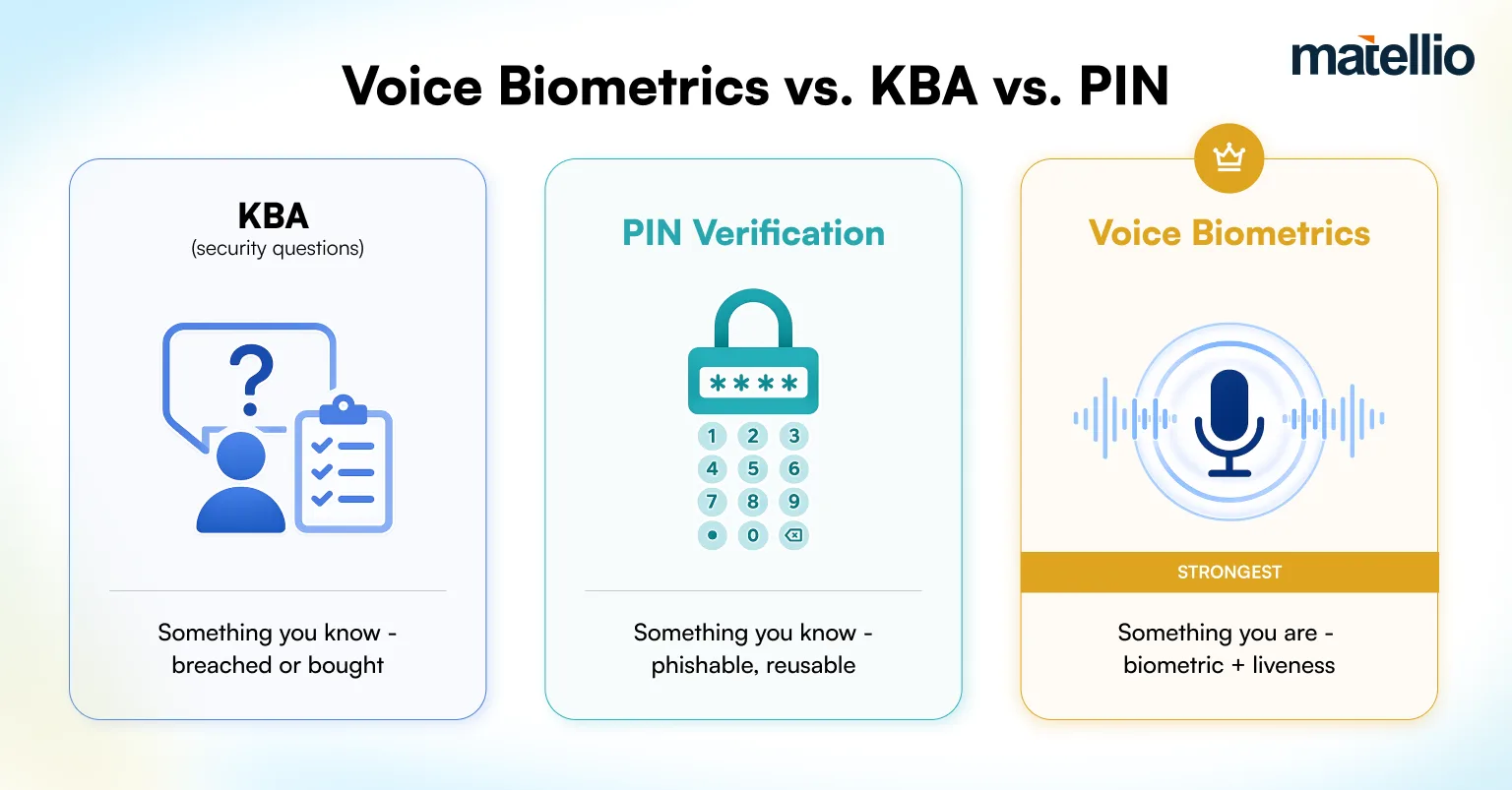
At a glance, here is how voice biometrics compares with the two shared-secret methods it replaces — a comparison examined in more depth alongside other call center authentication solutions:
| Dimension | Voice Biometrics | KBA (Security Questions) | PIN Verification |
|---|---|---|---|
| Security factor | Something you are (biometric) | Something you know (biographical) | Something you know (memorized secret) |
| Customer friction | Very low – works during natural speech | High – questions; legitimate callers lock out | Moderate – recall, entry, and resets |
| Fraud resistance | High vs. impostors; strong with liveness | Low – answers breached or bought | Low–moderate – phishable, reusable |
| Deepfake resistance | Yes – with synthetic-speech + liveness | None – a clone reads stolen answers | None – a clone reads the stolen PIN |
| U.S. regulatory standing | Recognized biometric factor in MFA | Withdrawn by NIST 800-63B | Single factor – inadequate alone |
Where voice biometrics fits in a layered fraud-prevention stack
Authentication via voice biometrics is strongest when it is not the only control. No single factor should be an on/off switch for account access, so voice biometrics works best as the low-friction identity anchor inside a risk-based decision that combines several signals and only escalates when risk is elevated:
- Pre-answer risk scoring: validate the calling number against network signaling (ANI / spoof detection) and score carrier metadata before the call is routed — the same signals that underpin phone and caller ID spoofing prevention.
- Passive voice biometrics + liveness: authenticate the enrolled caller in the background, with synthetic-speech detection to defeat clones and recordings.
- Behavioral and device signals: layer in call-pattern and device reputation so a weakness in one control is compensated by another.
- Risk-based step-up: reserve additional challenges for genuinely high-risk calls instead of interrogating every legitimate customer.
Deployed this way, voice biometrics does the heavy lifting on the common case — verifying good callers instantly — while spoof scoring and behavioral analysis catch the edge cases, and step-up handles the genuinely risky ones. That is the layered-security principle regulators now expect the contact center to meet, not just online banking, and it is the backbone of an effective contact center fraud prevention program.
Oracle OCCAS: the orchestration core behind voice biometrics
Voice biometrics is not a single product bolted onto the IVR; it is an orchestration problem across signaling, biometric scoring, and a real-time trust decision. Matellio solves it with Oracle Communications Converged Application Server (OCCAS) as the core platform. OCCAS sits above the bank’s existing SIP telephony and coordinates every step of the inbound call in real time, so voiceprint matching, deepfake detection, and risk-based routing run as one program rather than as disconnected point tools. Matellio’s OCCAS integration delivers this as an overlay, without a rip-and-replace of the contact center.
Processing SIP signaling
As each inbound call is set up, OCCAS processes the SIP signaling on the path and taps the live media stream for the authentication engine. Because it operates in the signaling and media layer rather than inside a single IVR product, it can apply the same policy whether the caller lands in self-service or with a live agent, and it can invoke step-up or reroute the call the moment risk changes — all without interrupting the conversation.
Integrating voice biometrics and deepfake detection services
OCCAS orchestrates the calls out to the specialized services in real time: it streams audio to the passive voice-biometrics engine for a voiceprint match, to the synthetic-speech classifier for deepfake and liveness scoring, and gathers caller-number and behavioral signals in parallel. It normalizes those results into a single trust decision, so the bank can swap or add a provider behind the orchestration layer without re-plumbing the contact center.
Enabling real-time call orchestration
The voiceprint match, deepfake score, liveness result, and behavioral signals feed a real-time routing decision in the call path: low-risk callers proceed with no friction, elevated-risk calls are stepped up, and high-risk calls are sent to a specialist fraud queue. The same OCCAS layer also secures the outbound side — branded caller ID and STIR/SHAKEN attestation — so inbound authentication and outbound call integrity run on one platform with shared policy and reputation signals.
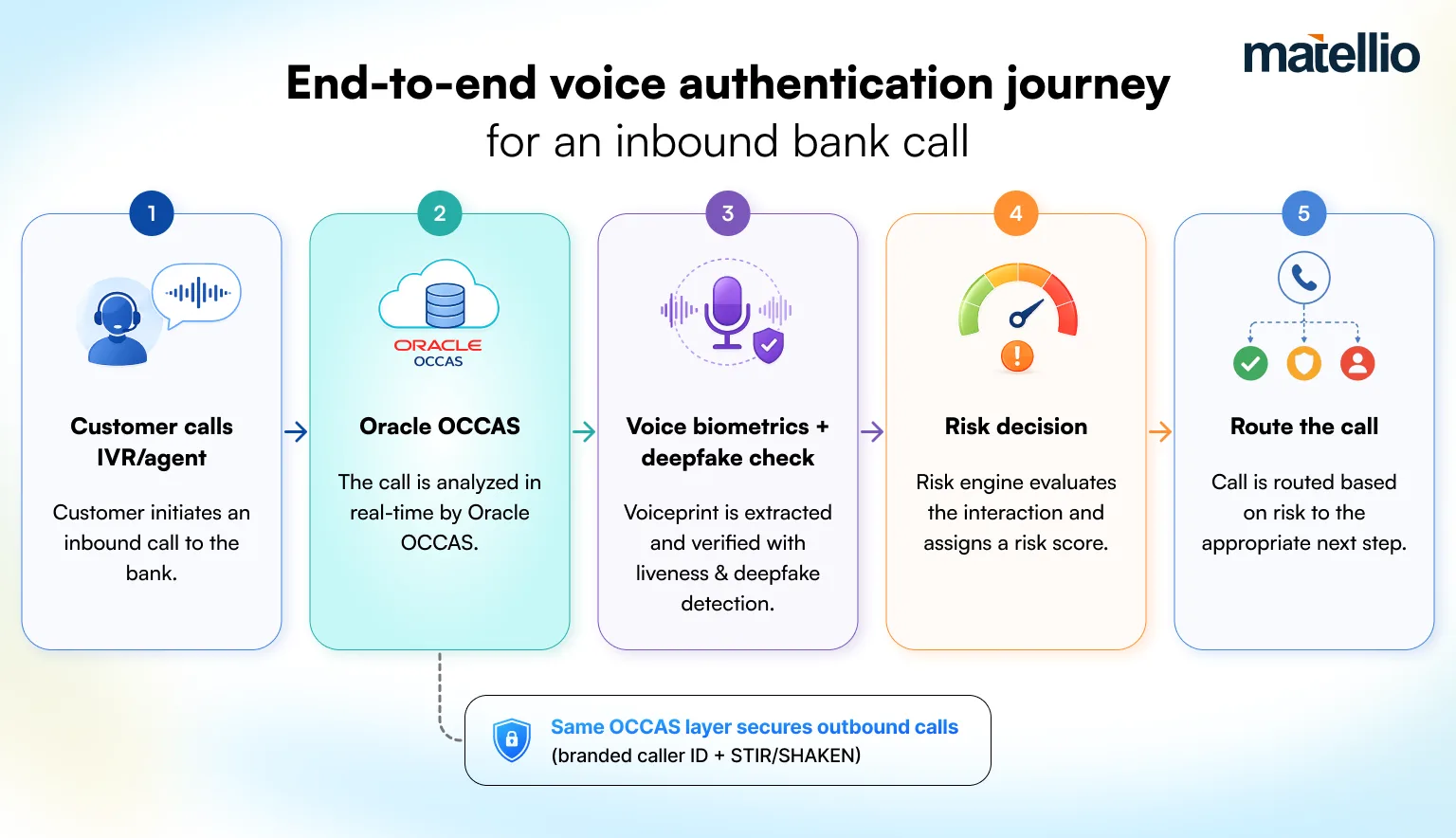
End-to-end voice authentication journey: the inbound call routes through OCCAS, which orchestrates voiceprint matching, deepfake and liveness checks, and a risk decision before the call is allowed, stepped up, or sent to a fraud queue.
Why Oracle OCCAS?
OCCAS is not a lightweight middleware layer; it is a carrier-grade application server built for the demands of real-time telecom, which is what makes it the right foundation for a bank’s voice-trust program:

Five reasons OCCAS anchors a bank’s voice-trust program — and why it adds remediation and monitoring as an overlay, without replacing the contact center.
- Carrier-grade architecture: engineered for the reliability and latency profile of live voice traffic, so authentication happens within the first seconds of a call rather than as a batch step.
- SIP Servlet capabilities: a standards-based SIP Servlet runtime for building and orchestrating real-time call logic — biometric scoring, deepfake checks, routing, and step-up — directly in the signaling path.
- Oracle SBC integration: works with the Oracle Session Border Controller to secure the network edge and normalize SIP across carriers and the bank’s internal telephony.
- Scalability: scales horizontally to absorb call-volume spikes — fraud events or seasonal peaks — without degrading authentication latency.
- High availability: clustered, redundant deployment so authentication stays up during peak volume and infrastructure events.
Because OCCAS deploys as an overlay above existing SIP infrastructure, banks add voice biometrics and deepfake detection without a rip-and-replace of the contact center or telephony platform.
The business value for banks
Voice biometrics delivers value on several axes at once, which is why it draws budget from fraud, security, and contact-center owners together:
- Reduced fraud losses: blocking impostors and AI-cloned voices at the point of entry stops account-takeover attempts that defeat KBA and PINs, cutting fraud losses and downstream remediation cost.
- Improved customer experience: customers are verified as they speak naturally, so legitimate callers are no longer interrogated with security questions or locked out for failing them.
- Lower authentication effort: passive enrollment and background matching remove the manual verification burden from agents and the memory burden from customers.
- Faster call handling: removing the knowledge-based question-and-answer step and its failed-verification escalations shortens average handle time and frees agent minutes for the actual reason for the call.
How to deploy voice biometrics without replacing your contact center
A common question from bank technology teams is simply how to use voice biometrics without disrupting live operations. Modern voice-security platforms deploy as an orchestration layer above existing SIP or cloud telephony, integrating with the IVR and agent desktop rather than replacing the platform. That means you can add voice biometrics incrementally, starting with the highest-risk call flows. A practical rollout looks like this:
- Map your risk. Identify the highest-value phone interactions — wire confirmations, account recovery, profile changes, card disputes — and treat them as your first protected flows.
- Enroll passively. Build voiceprints from prior recorded calls where consent and policy allow, so customers are covered without a disruptive enrollment campaign.
- Add liveness and deepfake detection from day one. Never ship a voiceprint match as a standalone gate; pair it with synthetic-speech scoring before it touches production.
- Orchestrate above your telephony. Insert authentication into the call path as an overlay so there is no rip-and-replace and no contact-center outage.
- Tune the risk policy. Set match-confidence thresholds and step-up rules to your fraud appetite, then monitor false accepts, false rejects, and handle time.
This is the model we build for banks. We help banks deploy passive voice biometrics, deepfake detection, and inbound spoof scoring as an orchestration layer over existing telephony through our OCCAS voice security implementation, with routing and step-up logic tuned to each institution’s risk policy. For banks moving to a cloud contact center, the same layer applies during an Amazon Connect migration, so authentication modernization and platform modernization happen together rather than as two disruptive projects.

Frequently asked questions
1. How does voice biometrics work in banking?
2. Is voice recognition safe for banking?
3. How can a bank use voice biometrics for authentication?
4. Does voice biometrics stop AI voice cloning and deepfakes?
5. What is the difference between passive and active voice biometrics?
6. Do banks have to replace their contact center to add voice biometrics?
Sources
- FTC — New data show fraud losses of $12.5B in 2024; phone is the #2 contact method with the highest median loss (~$1,500) — https://www.ftc.gov/news-events/news/press-releases/2025/03/new-ftc-data-show-big-jump-reported-losses-fraud-125-billion-2024
- FTC — Consumer Sentinel Network Data Book 2024 — https://www.ftc.gov/reports/consumer-sentinel-network-data-book-2024
- Pindrop — 2025 Voice Intelligence & Security Report (synthetic voice attacks at banks +149%; fraud every ~46 seconds; 1.2B+ calls analyzed) — https://www.pindrop.com/research/report/voice-intelligence-security-report/
- NIST SP 800-63B, Digital Identity Guidelines — KBA withdrawn as an acceptable authenticator — https://pages.nist.gov/800-63-4/sp800-63b.html
- FFIEC — Authentication and Access to Financial Institution Services and Systems (2021) — https://www.ffiec.gov/sites/default/files/media/press-releases/2021/authentication-and-access-to-financial-institution-services-and-systems.pdf
- OCC Bulletin 2021-36 — FFIEC authentication guidance — https://www.occ.gov/news-issuances/bulletins/2021/bulletin-2021-36.html
Author Bio

VP- Account Management at Matellio


